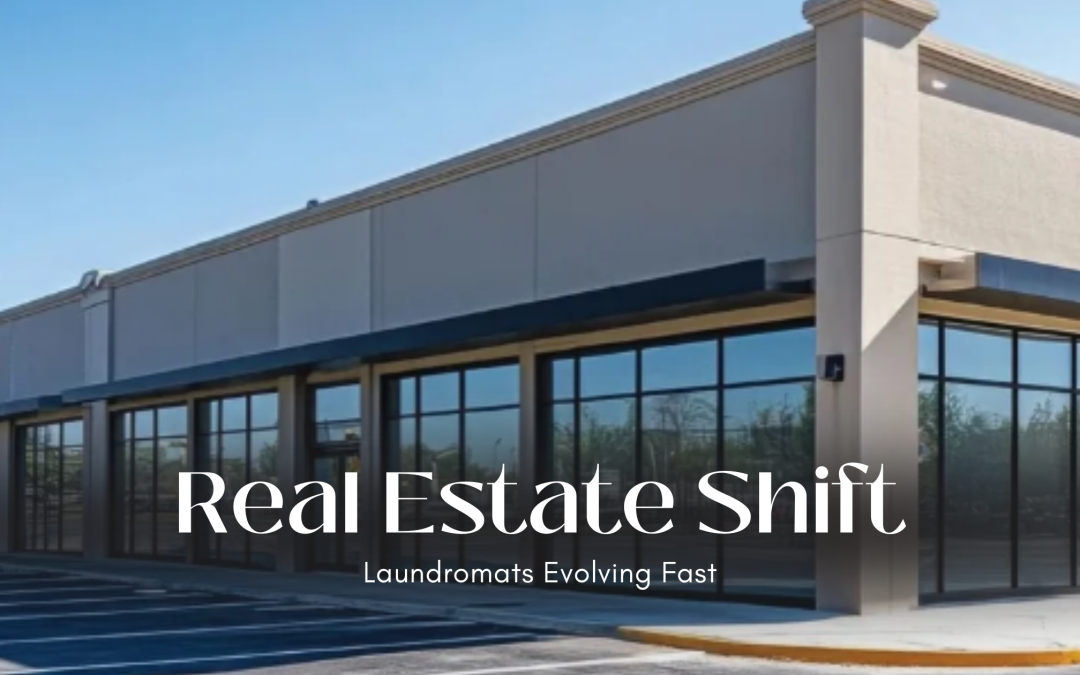
Laundromat real estate has seen a boom in recent years, thanks partially to an increase in publicity around the laundromat business via social media. The sector is now seeing significant activity as vacancy rates fall, rents rise, and operational models expand beyond self-serve coin-op to service-driven concepts like drop-off, pickup and delivery, and commercial accounts. That shift is creating new opportunity—and new pressure—for operators and investors alike.
Demand From All Directions
“There’s an extremely high demand for existing stores — I’ve never seen it higher than it is right now,” said John Vassiliades, a longtime laundromat broker. “People are coming in from all walks of life. Less mom and pop, more professionals. Some are leaving corporate jobs. Some are investors who want to scale quickly.”
According to Vassiliades, manufacturers and distributors are fueling demand as well as they build stores themselves or franchising. “They’re building some decent stores, usually 5,000 square feet. Some as large as 17,000.”
Roger Marks, a broker with decades in commercial real estate and laundry site selection, sees the same evolution. “It’s a more sophisticated customer entering the space,” Marks said. “There’s definitely more capital. But that also means competition for the best sites is stiff.”
A Tight Retail Market
That competition is amplified by macro trends. CBRE reports that retail vacancies across well-located neighborhood, community, and strip centers are at historic lows. New retail supply has been limited since the Great Recession, and real estate availability is expected to remain tight through 2025.
“We’re in this Amazon world where people get this idea that retail real estate is plentiful and that there aren’t as many brick and mortar stores anymore,” Marks said. “The reality is that good real estate has a way of getting gobbled up, and so you are in competition with not just laundromats, but things like med-tail. It’s very competitive.”
Asking rents continue to rise, even in markets with vacancies, due to pressure from lenders to preserve asset values. “Landlords are under the gun from their banks,” Vassiliades said. “If they reduce rental rates, it devalues the property. And that can jeopardize their financing. So even with vacancies, they’re holding firm or raising prices.”
Leasing: What to Look For
For the many operators who lease space, brokers stress the importance of careful negotiation and long-term thinking.
“You want a long lease. Minimum 10 years, ideally with multiple five-year options,” Vassiliades said.
And you have to make sure you’re paying close attention to details with your lease, especially as it relates to the renewal windows. “It’s important to stay on top of those renewal windows,” Marks said. “I’ve seen people miss their renewal windows and the landlord was right on top of it and those tenants lose a good location.”
Marks and Vassiliades both recommend:
- 25-year control: Whether through an initial term or options, aim for at least 25 years of control over the space.
- Assignment rights: The lease should be assignable, so you can sell the business down the road without risking the location.
- Clear construction timeline: Especially in new builds, negotiate rent abatement until the store is operational—and document all permitting and construction deadlines.
- CAM and tax transparency: Make sure common area maintenance (CAM), real estate taxes, and other expenses are clearly defined and predictable.
- Occupancy cost discipline: Total rent, including CAM and taxes, should ideally stay under 25% of projected gross revenue.
“Most people don’t think about this upfront,” Marks said. “But that lease will either protect your investment or make it harder to sell or grow. You have to build in flexibility and time.”
The increasing number of new stores coming to market with a modern look and layout are impacting perceptions of laundromats as well, which can be helpful when property owners are evaluating lease agreements.
“Because of the ways stores have improved in terms of build out, that perception is better than it was over the years,” Marks said. “There was a time when there was a negative connotation to having a laundromat in your center but I think we’ve gotten over that.”
Own or Lease? Buy or Build?
Rising rents and growing sophistication in the market are prompting a new question: Should you build from scratch (de novo), or buy an existing store?
Each path has trade-offs.
“New builds are beautiful,” Vassiliades said. “But they’re expensive—$2 to $3 million for a 5,000 to 7,000 square foot store. That pushes a lot of people toward acquisition. If you can buy a store for $500,000 that’s already cash flowing, it’s often the better deal.”
Still, acquiring an existing location comes with its own challenges: aging infrastructure, legacy layouts, limited space for services, and poor equipment placement can hinder modernization.
“A lot of the older stores weren’t designed for today’s business models. They’re long and narrow,” Marks said. “They were built for top-load washers and walk-in traffic—not pickup and delivery or commercial accounts. If you’re buying, you have to evaluate whether the space can evolve with your business.”
De novo builds allow for full customization, better zoning control, optimized parking, and modern infrastructure, but they require time, capital, and real estate savvy. In some cases, vacant lots or former standalone retail spaces can offer cost-effective options for experienced operators willing to work and wait through the zoning and construction process.
Bigger Stores, More Services
Regardless of path, today’s real estate must support more than rows of machines.
“You need extra space. You need parking. If I were building today, I’d go 4,000 to 5,000 square feet minimum,” Vassiliades said. “And you better have parking for 30 cars.”
The reason? Services are increasingly important as profit centers generating high margin for operators.
Drop-off, pickup and delivery, and commercial accounts are growing rapidly, often with two to three times the margin of traditional self-service. “You make 75 to 85 cents on the dollar with drop-off,” Vassiliades said. “That’s why you’re seeing all these service expansions. It’s about keeping those machines running 24 hours a day.”
Marks added that operators are starting to think in hub-and-spoke models: one large store for processing, surrounded by smaller drop-off locations.
“It’s not always about putting in 20 identical stores anymore,” Marks said. “You might need one production store and several satellite stores with just a few machines and lockers. That’s a different real estate play.”
The Road Ahead
As entrants to the market are increasingly oriented toward growing at scale, the industry will see a continue evolution with consolidation expected. Vassiliades pointed to one group in Chicago with at least 16 stores, and others in St. Louis with a dozen or more. “Some of these groups are looking to buy dozens,” he said. “But a lot of existing owners just aren’t selling because the stores are cash flowing 20 to 25 percent. That’s hard to beat.